Vertical API Integration: How Piramal Pharma Builds Supply Chain Resilience for Global Clients
October 23, 2026

The pharmaceutical supply chain has never faced a stress test quite like this one. Geopolitical tensions, tariff escalations, and concentrated manufacturing dependencies have converged in 2026 to expose a structural flaw that the industry spent decades ignoring: the fragility of the fragmented, multi-vendor API supply model.
Piramal Pharma has built a different model. By integrating raw materials, intermediates, API manufacturing, and drug product execution across a global network, Piramal Pharma gives clients a more resilient way to keep supply moving when individual links fail.
The numbers are stark. According to FDA analysis cited by CPHI, approximately 80% of API manufacturing facilities supplying the US market are located outside the United States, with the largest concentrations in China and India. The global API market, valued at USD 287.1 billion in 2026, is growing at 5.6% CAGR through 2033, but that growth trajectory means little if supply continuity cannot be guaranteed.
For pharmaceutical and biotech companies evaluating their CDMO partnerships, the question has shifted. It is no longer "who can manufacture this API?" It is "who controls enough of the supply chain to guarantee it won't break?"
Vertical API integration is the answer the industry has landed on. And for global clients navigating this environment, Piramal Pharma has built precisely the infrastructure that makes that answer actionable.

Why Fragmented Supply Chains Are No Longer Acceptable
The traditional model of pharmaceutical outsourcing relied on a web of specialized vendors. One supplier handled raw materials, another handled key starting materials, a third supplied intermediates, and a fourth produced finished API. Each handoff introduced risk. Each vendor relationship required its own qualification, audit cycle, and regulatory filing. When one link broke, the entire chain stalled.
That model worked tolerably well in stable geopolitical conditions. In 2026, it has become a liability.
The Three Pressure Points Driving Change
- Geopolitical concentration risk. The industry's dependence on a small number of manufacturing geographies for APIs and intermediates has been laid bare by trade restrictions and tariff regimes. Companies that relied on single-region sourcing have faced supply disruptions and cost shocks simultaneously.
- Regulatory complexity across jurisdictions. As pharmaceutical companies pursue geographic diversification, they encounter a multiplying set of regulatory requirements. Each new manufacturing site requires separate approvals from agencies including the US FDA, UK MHRA, and Japan's PMDA, a process that can take years without an experienced partner already holding those approvals.
- Technology transfer risk between vendors. Every time a molecule moves from one CDMO to another, data integrity, process knowledge, and quality standards must be re-established. Research from the 2026 CPHI Outsourcing Outlook confirms that pharmaceutical companies are actively seeking "fewer, more strategic partners who can carry assets seamlessly from development through to commercial manufacturing" precisely to eliminate these transfer risks.
The strategic shift: McKinsey research identifies vertical integration for strategically critical materials as one of the core resilience strategies being adopted by leading pharmaceutical companies in response to current supply chain volatility.
The implication is clear: supply chain resilience is no longer a procurement function. It is a strategic capability that must be built into the CDMO partnership itself.
Piramal Pharma: Vertical Integration by Design
Piramal Pharma did not build vertical API integration as a response to the current crisis. It built it as a foundational business model, and that foresight is now a decisive competitive advantage for its global clients.
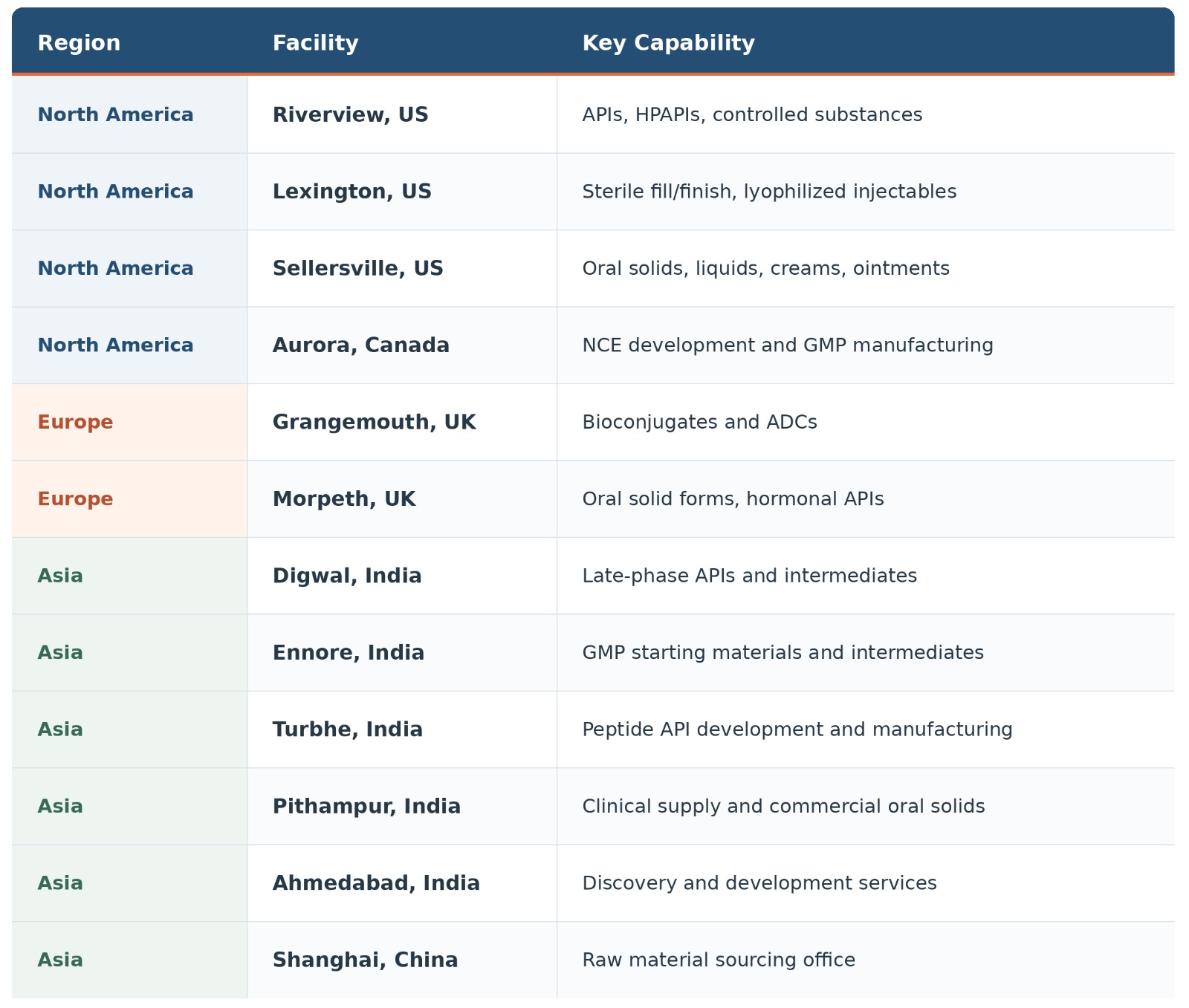
The Piramal Pharma supply chain spans the entire API value chain, from GMP starting materials and intermediates through to late-phase and commercial API manufacturing, and onward to finished drug product. This is not a marketing claim. It is a physical reality, executed across a globally integrated network of 15 facilities on three continents.
The Backward Integration Model: From API to Starting Materials
For small-molecule chemistry, Piramal Pharma takes direct responsibility for the full upstream supply chain. This means:
- GMP starting materials and intermediates are manufactured at the Ennore, India facility
- Raw material sourcing is supported through a dedicated procurement center in Shanghai, China
- Late-phase APIs and intermediates are produced at Digwal, India
- Commercial API manufacturing scales through multiple facilities in India and the US, including Riverview, US for HPAPIs
This backward integration model means that when a client partners with Piramal Pharma for API supply, they are not contracting a single manufacturing step. They are securing a controlled, auditable supply chain that Piramal Pharma owns and manages from the earliest precursor through to the finished drug substance.
Why this matters for supply continuity: When a primary raw material source faces a disruption, Piramal Pharma does not need to scramble across an external vendor network. The routing decision happens internally, within a pre-validated, pre-approved manufacturing architecture. That is a fundamentally different risk profile than what a fragmented supply model offers.
The Facility Network: Geographic Resilience Built In
This geographic distribution is not incidental. It is the structural basis of supply chain resilience: the ability to manufacture in the US, Europe, or Asia depending on where regulatory approvals, client preferences, and geopolitical conditions make the most strategic sense.

Specialized API Capabilities That Demand Vertical Control
Vertical integration delivers its highest value not in standard small-molecule manufacturing, but in complex, high-value modalities where upstream material quality directly determines downstream process performance. Piramal Pharma has built specialized capabilities across several of these high-stakes categories.
High Potency APIs (HPAPIs)
With over 50 years of experience in manufacturing, handling, and containment of highly potent compounds, Piramal Pharma's Riverview, US facility handles cGMP production of HPAPIs from gram to kilogram scale. The containment requirements for these compounds make upstream supply chain control especially critical: any quality deviation in starting materials or intermediates can compromise the entire batch.
The vertical advantage here is direct: Piramal Pharma's ability to control and qualify the precursor supply chain for HPAPIs reduces the risk of contamination, impurity introduction, and supply interruption at the most sensitive stage of manufacturing.
Peptide APIs
Piramal's Turbhe, India facility brings a 40-year legacy in peptide API development and manufacturing, offering both solution-phase and solid-phase synthesis. Peptide manufacturing is particularly sensitive to raw material quality and upstream process consistency. Vertical integration into the supply of amino acid building blocks and other critical reagents provides the quality assurance that complex peptide programs require.
Antibody Drug Conjugates (ADCs)
ADC manufacturing at Piramal Pharma's Grangemouth, UK facility combines antibody, linker, and payload manufacturing under one roof. The 2026 CPHI Outsourcing Outlook specifically notes that for complex modalities like ADCs, "upstream material quality directly affects downstream process performance, impurity burden, and ultimately product quality," making vertically integrated supply models the preferred structure.
Vaccines and Biologics
Through its associate company Yapan Bio, Piramal Pharma extends its integrated capabilities to large molecules at its Hyderabad, India facility. As the biologics and vaccine pipeline continues to grow, the same supply chain resilience principles that apply to small molecules apply with even greater force to the temperature-sensitive, process-dependent world of biologic manufacturing.
Key takeaway: In each of these specialized modalities, vertical integration is not a convenience. It is a quality and compliance requirement. The alternative, sourcing critical upstream materials from uncontrolled third parties, introduces variability that regulatory agencies and patients cannot afford.
Integrated Program Management: The Coordination Layer That Makes It Work
A globally distributed facility network only delivers supply chain resilience if it is coordinated effectively. Physical infrastructure without organizational coordination is just a collection of buildings. Piramal Pharma solves this through its Integrated Program Management (IPM) model.
Every client engagement is assigned a dedicated Integrated Program Manager who serves as a single point of contact across all geographies, facilities, and functional teams. This person coordinates:
- Technology and documentation transfers between sites
- Regulatory submissions and compliance across multiple jurisdictions
- Timeline management for complex, multi-site programs
- Communication between client teams and Piramal Pharma research, operations, and quality functions

Why Single-Point Accountability Changes the Risk Equation
In a fragmented CDMO model, the client bears the coordination burden. They manage the interface between their API supplier, their drug product manufacturer, their packaging partner, and their regulatory consultant. Each of those interfaces is a point of failure.
Under the Piramal Pharma IPM model, that coordination burden transfers to Piramal Pharma. The client retains strategic oversight while Piramal Pharma takes operational ownership of the integrated program. This is not a minor convenience; it is the difference between a supply chain that functions as a system and one that functions as a series of independent transactions.
The regulatory dimension is particularly important. Piramal Pharma facilities have undergone more than 340 regulatory inspections and over 1,740 customer audits. This inspection history means that when a client needs to file for approval in the US, UK, EU, or Japan, they are working with a partner whose facilities are already known to those regulators, rather than introducing new sites into an already complex approval process.
As the 2026 CPHI Outsourcing Outlook notes: "Strategic partnership selection reduces tech transfer risks, improves continuity, and supports long-term co-investment and collaboration models." The IPM structure is precisely what makes that continuity possible at scale.
From Clinical Supply to Commercial Scale: A Continuous Chain
One of the most underappreciated supply chain risks in pharmaceutical development is the transition from clinical to commercial manufacturing. Companies that use one CDMO for Phase I/II and a different partner for commercial scale face a technology transfer event at the worst possible moment: when speed to market matters most and regulatory scrutiny is highest.
Piramal Pharma eliminates this transition risk by design. Its integrated capabilities cover the full development arc:
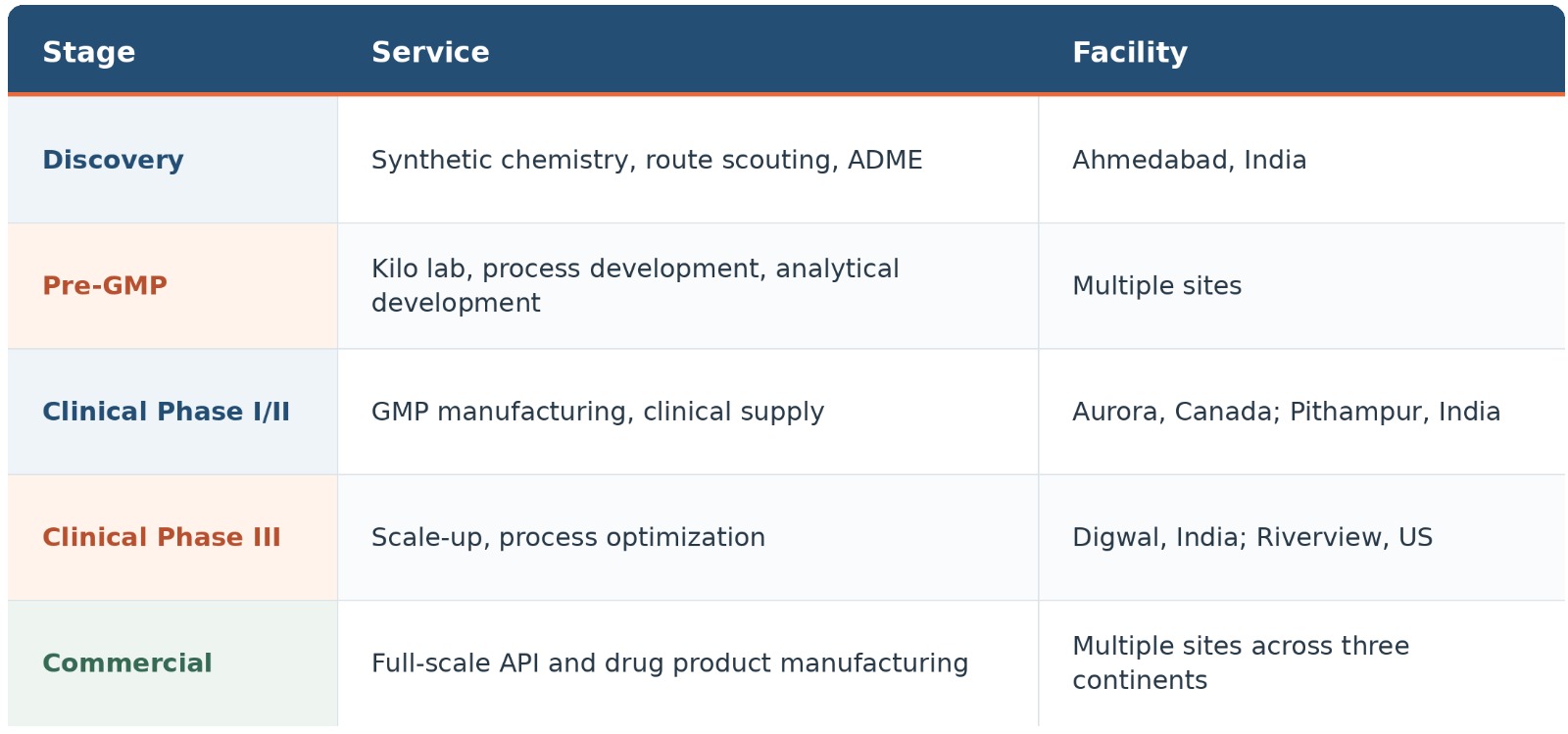
The Development-to-Commercial Pathway at Piramal Pharma
This continuity matters because process knowledge does not transfer perfectly between organizations. When the same team that developed the process also scales it to commercial production, the institutional memory stays intact. Batch records, process parameters, analytical methods, and quality standards evolve together rather than being re-established from scratch at a new vendor.
For innovator companies, this means faster time to market. For generic companies, it means reliable supply of off-patent APIs from a partner with decades of manufacturing history. Piramal Pharma's Generic API division provides a diverse range of off-patent APIs tailored for global markets, backed by the same integrated supply infrastructure that supports its innovator programs.
The scale flexibility is equally important. Piramal Pharma supports manufacturing from milligrams to kilograms, from lab scale through kilo lab, pilot scale, and full commercial GMP production. A client does not need to re-qualify a new partner as their program grows. The infrastructure to support them at every stage already exists within the Piramal Pharma network.
Supply Chain Resilience as a Strategic Differentiator
The pharmaceutical industry is re-evaluating what CDMO partnership means. The old model, transactional, cost-optimized, and geographically concentrated, has proven brittle. The new model demands resilience, integration, and a partner who can absorb disruption without passing it to the client.
Key Takeaways
- Vertical API integration reduces dependence on fragmented vendors
- Piramal Pharma controls more of the supply chain from upstream inputs to finished product
- Integrated program management lowers coordination risk across sites and functions
- Global manufacturing depth gives clients flexibility when regulation or geopolitics shift
Vertical API integration is not a feature. It is an architecture. And architecture takes years to build.
Piramal Pharma has spent over six decades building that architecture, accumulating 60 years of API manufacturing experience, establishing a multi-continental facility network, and developing the regulatory relationships that allow its clients to manufacture in their preferred geographies without starting from zero.

What Clients Actually Gain
The supply chain benefits of vertical integration with Piramal Pharma translate into concrete operational outcomes:
- Reduced supply chain risk through backward integration into starting materials and intermediates, eliminating dependence on external vendors for critical upstream inputs
- Faster regulatory clearance through an existing network of pre-inspected, multi-agency-approved facilities across the US, UK, EU, and Asia
- Eliminated technology transfer events by keeping programs within a single, integrated CDMO network from development through commercial scale
- Geographic flexibility to manufacture in the region that best serves regulatory, cost, and geopolitical requirements at any given point in the product lifecycle
- Single-point accountability through the IPM model, which places coordination ownership with Piramal Pharma rather than the client
The macro context reinforces the urgency. The global CDMO market reached USD 186.4 billion in 2024 and is projected to grow at 8.2% CAGR through 2030. That growth is being driven by pharmaceutical companies recognizing that building internal manufacturing capacity is neither efficient nor resilient. The question is not whether to outsource. It is which partner has the integration depth to make outsourcing genuinely safe.
For global clients who cannot afford supply chain failures, the answer requires a CDMO with vertical control from raw material to finished product, regulatory approvals across multiple jurisdictions, and the organizational infrastructure to coordinate it all. That is what Piramal Pharma has built.
To explore Piramal Pharma's integrated supply chain capabilities and discuss how vertical API integration can strengthen your program's supply resilience, visit Piramal Pharma.
Frequently Asked Questions
What is vertical API integration in pharma?
Vertical API integration means one CDMO controls more of the supply chain, from starting materials and intermediates through API and sometimes drug product. That reduces handoff risk, improves visibility, and helps keep quality and timelines more stable across development and commercial manufacturing.
Why does vertical integration improve supply chain resilience?
It improves resilience by reducing dependence on multiple external vendors for critical inputs. When sourcing, manufacturing, and program coordination sit inside one network, disruptions are easier to reroute, tech transfer risk drops, and regulatory and quality oversight becomes more consistent.
Which programs benefit most from integrated API supply chains?
Complex programs benefit most, especially HPAPIs, peptides, ADCs, and other molecules where upstream material quality affects downstream performance. These programs also gain from a single partner that can move them from clinical supply to commercial scale without restarting the transfer process.
How does Piramal Pharma support continuity across geographies?
Piramal Pharma operates a global network across North America, Europe, and Asia, which allows programs to be aligned with client, regulatory, and market needs. That geographic flexibility helps reduce concentration risk while keeping manufacturing and supply planning under one coordinated model.
What is the advantage of integrated program management?
Integrated program management gives clients a single point of accountability across sites, functions, and jurisdictions. Instead of managing multiple suppliers and handoffs, clients work through one coordinated team that owns communication, transfers, timelines, and execution.


Latest Blogs
21.10.2026
The Role of Critical Care Medicines in Modern Healthcare
Critical care medicines are hospital medicines used to support patients during surgery, intensive care and medical emergencies.
Read More: The Role of Critical Care Medicines in Modern Healthcare
15.10.2026
Innovation Beyond the Laboratory
Pharma R&D innovation does not stop at the laboratory. It also shapes how medicines are developed, manufactured, supplied and made accessible to patients
Read More: Innovation Beyond the Laboratory
12.10.2026
Innovation a Key Enabler in Pharmaceuticals
Innovation matters in pharmaceuticals because it makes pharmaceutical development more efficient, informed and scalable.
Read More: Innovation a Key Enabler in Pharmaceuticals