Drug Discovery Process Explained: A Step-by-Step Guide (2026)
June 17, 2026

Introduction
Bringing a new medicine to patients is one of the most demanding undertakings in the pharmaceutical and healthcare industry. From the earliest hypothesis about a biological target to a compound ready for clinical evaluation, the drug discovery process can span years and involve hundreds of scientific decisions that determine whether a program advances or stalls.
For organizations operating in pharmaceutical drug development, understanding each stage is the foundation on which credible research strategies and productive partnerships are built.
What Is Drug Discovery?
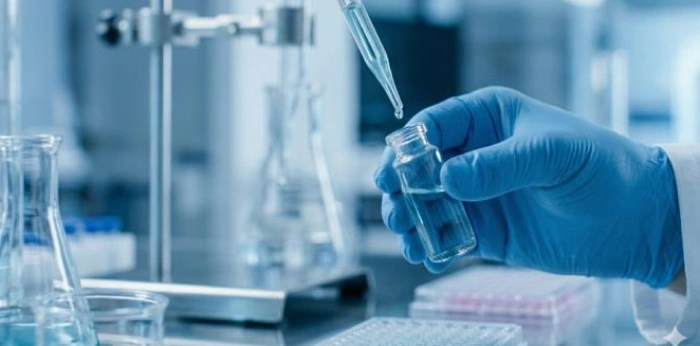
Drug discovery is the process of identifying, characterizing, and optimizing compounds with the potential to treat, prevent, or diagnose disease. It is the earliest phase of pharmaceutical drug development and establishes the scientific foundation on which all subsequent clinical and regulatory work depends.
The quality of decisions made here directly influences the probability of success in later stages. Programs that reach the clinic with well-validated targets and rigorous preclinical data are significantly more likely to deliver outcomes that matter.
Step-by-Step: The Four Core Stages
Step 1: Target Identification
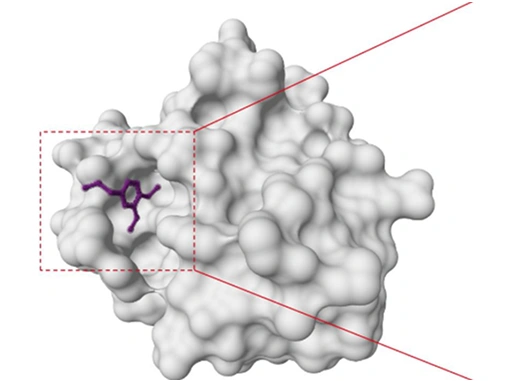
Every successful program begins with a clearly defined and scientifically validated target. This involves pinpointing the specific protein, gene, or biological pathway whose modulation is expected to produce a therapeutic effect. The work draws on genomics, proteomics, structural biology, and translational medicine, and increasingly benefits from real-world clinical and biomarker data that strengthens the linkage between laboratory biology and actual patient populations. A poorly validated target is among the most costly mistakes in pharmaceutical drug development. Rigorous validation at this stage is not a time investment; it is a risk mitigation measure with significant downstream implications for the entire program.
Step 2: Hit Discovery
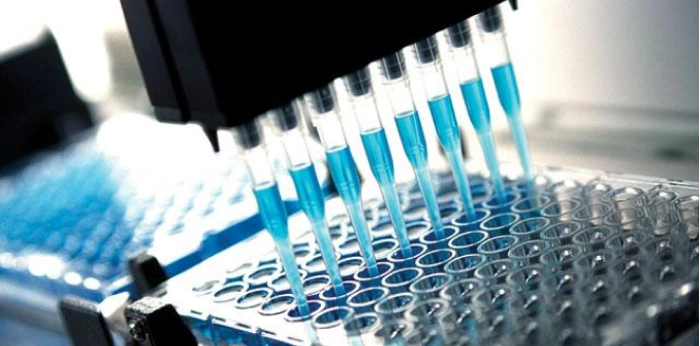
With a validated target, the next step is identifying chemical matter that interacts with it through systematic screening of compound libraries. High-throughput screening platforms can evaluate hundreds of thousands of compounds within weeks, while complementary approaches such as fragment-based screening, DNA-encoded libraries, and virtual screening expand coverage for targets that are difficult to address through conventional methods. A well-executed campaign delivers chemically distinct, confirmed actives with defined structure-activity relationships and a credible path toward optimization.
Step 3: Lead Optimization
Hit compounds are starting points, not drug candidates. Lead optimization transforms a promising hit into a compound with the profile required for clinical development. This demands simultaneous improvement across potency, selectivity, pharmacokinetics, and safety margins. The compound must engage the target at therapeutically relevant concentrations, act specifically on the intended target without triggering off-target risks, demonstrate acceptable absorption, distribution, metabolism, and excretion behavior, and maintain an adequate window between the efficacious dose and the toxic dose. Programs that lack clear go/no-go criteria and disciplined iteration tend to drift, generating incremental improvements without ever converging on a developable candidate.
Step 4: Preclinical Testing
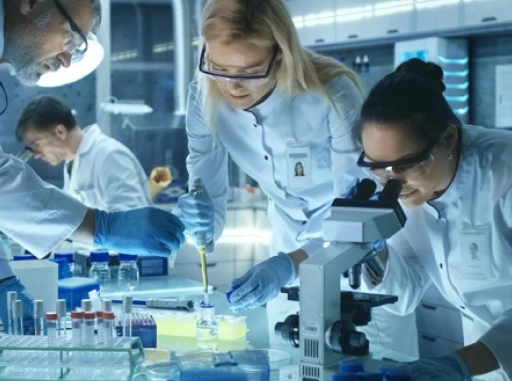
Before entering human trials, a compound must meet a defined standard of evidence across safety, pharmacology, and biological behavior. Preclinical testing addresses this through a structured program of in vitro and in vivo studies covering toxicology, pharmacology, ADME characterization, and genotoxicity assessment. Toxicology studies establish organ-specific risk, maximum tolerated dose, and the reversibility of any findings. Pharmacology studies confirm the mechanism of action in disease-relevant models. ADME work characterizes how the compound moves through the body, and genotoxicity evaluation assesses its potential to cause DNA damage. Regulatory agencies including the FDA and EMA require a complete preclinical data package before an IND application can be submitted. Engaging experienced pharmaceutical drug development services teams ensures that study design, data quality, and regulatory documentation meet the standards that will face scrutiny at the submission stage.
How Technology Is Reshaping Drug Discovery
Faster Screening
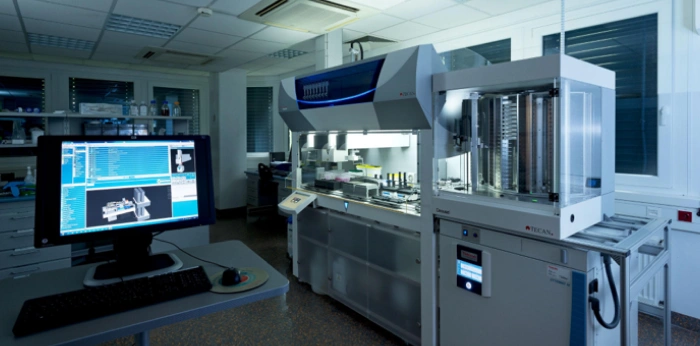
Throughput has historically been the limiting factor in hit discovery. Automated platforms and miniaturized assay formats have fundamentally changed this.
- Parallel assays across hundreds of thousands of compounds compress multi-year timelines
- Acoustic liquid handling and integrated data systems reduce per-compound costs
Organizations that have not modernized their screening operations face meaningful competitive disadvantage at the most foundational stage of the process
Predictive Modeling

Computational approaches have moved from supplementary tools to core components of lead optimization.
- Machine learning models forecast how structural changes affect potency and selectivity
- Molecular dynamics simulations provide insight into binding mode and residence time
- ADMET platforms identify liabilities in solubility, permeability, and metabolic stability before synthesis
- Where fully integrated, predictive modeling can substantially reduce the number of compounds needed to identify a development candidate
The Regional Ecosystem: Where Drug Discovery Is Happening
Drug discovery does not happen uniformly across geographies. Talent concentration, funding infrastructure, regulatory environment, and institutional density all shape where programs can be realistically built and sustained.
United States
- Dominant market for pharmaceutical and healthcare research by investment and organizational density
- Innovation clusters in Boston, San Francisco, San Diego, and New York form self-reinforcing ecosystems
- FDA Breakthrough Therapy and Accelerated Approval pathways make the US the preferred first-filing jurisdiction for oncology and rare disease programs
United Kingdom
- The Golden Triangle connecting London, Oxford, and Cambridge remains one of the world's most productive research corridors
- The Francis Crick Institute and Wellcome Sanger Institute bridge fundamental biology and translational medicine
- Innovate UK, the BioIndustry Association, and the MHRA's pragmatic regulatory approach support pharmaceutical drug development partnerships in genomics, immunology, and precision medicine
Canada
- The SR&ED tax credit program offers among the most competitive R&D incentives in any G7 market
- Provincial ecosystems in Toronto, Montreal, and Vancouver are anchored by the University of Toronto, McGill, and UBC
- The National Research Council and Strategic Innovation Fund provide non-dilutive capital pathways for translational programs
Putting It Together
The drug discovery process is rarely as sequential as any framework suggests. Programs encounter unexpected biology, unanticipated safety signals, and compounds that fail in complex models despite strong early data. Iteration is not a sign of weakness; it is inherent to research conducted at the frontier of scientific knowledge.
What distinguishes programs that succeed is the discipline applied at each stage and the organizational capacity to make clear, evidence-based decisions about when to advance and when to stop. For organizations invested in pharmaceutical drug development, the science is always the starting point. The systems, partnerships, and infrastructure surrounding that science determine whether it ultimately becomes medicine.
Discover Cutting-Edge Drug Discovery Solutions
Translating a validated target into a clinical development candidate demands scientific excellence, fit-for-purpose infrastructure, and deep operational experience across every stage of the process. From high-throughput screening and lead optimization to comprehensive preclinical packages, the right partner brings both technical capability and institutional knowledge to advance programs with confidence.
Explore how integrated drug development services can support your discovery programs at every stage.


Frequently Asked Questions (FAQ's)
1. What is drug discovery and why is it critical?
Drug discovery is the process of identifying and optimizing compounds to treat or prevent diseases, forming the scientific foundation for all subsequent clinical development.
2. What are the key stages in the drug discovery process?
The process includes target identification, hit discovery, lead optimization, and preclinical testing, each building toward a clinically viable drug candidate.
3. Why is target identification so important?
A well-validated biological target significantly improves the chances of success, while poor target selection can lead to costly failures later in development.
4. How are hit compounds identified?
Through high-throughput screening and advanced methods like fragment-based and virtual screening, researchers identify compounds that interact with the target.
5. What happens during lead optimization?
Promising compounds are refined for potency, safety, selectivity, and pharmacokinetics to ensure they are suitable for human trials.
6. How is technology transforming drug discovery?
AI, machine learning, and predictive modeling are accelerating screening, improving decision-making, and reducing the number of compounds needed to reach viable candidates.
Latest Blogs
03.09.2026
How Digital Transformation Is Connecting People, Processes and Decisions Across Pharma
The pharmaceutical industry is no longer just about molecules, manufacturing lines, and regulatory filings.
Read More
27.08.2026
Career Growth in the Pharma Industry: What Can You Expect?
Choosing a career path is rarely just about a job title, it is about where that role can take you.
Read More
24.08.2026
Doing Well and Doing Good: Inside Piramal Pharma's Purpose-Led Culture
In an industry where innovation can directly influence lives, being a successful pharmaceutical company goes beyond business performance.
Read More