Building a Resilient Pharmaceutical Supply Chain in an Unpredictable World
August 17, 2026
Introduction
The pharmaceutical industry operates within one of the world's most complex and interconnected supply networks. A single disrupted shipment, a raw material shortage, or a geopolitical event on the other side of the world can delay a life-saving therapy from reaching a patient who needs it. Therefore, supply chain resilience is not simply an operational priority, it is essential to maintaining continuity of care and ensuring patients have access to critical medicines.
Building a resilient global pharmaceutical supply chain isn't a defensive move anymore, it's a competitive and moral imperative. It requires greater visibility, flexibility, diversification, technology, and collaboration across the value chain.
What Is a Global Pharmaceutical Supply Chain and Why Is It Important?
A global pharmaceutical supply chain encompasses the network of activities and stakeholders involved in bringing a pharmaceutical product from raw materials to the patient. This can include sourcing active pharmaceutical ingredients (APIs), excipients, packaging materials, and other inputs; pharmaceutical development and manufacturing; quality testing; warehousing; transportation; and distribution.
The global pharmaceutical supply chain plays a critical role in ensuring the availability, quality, and timely delivery of medicines worldwide. Its importance goes far beyond logistics. Unlike most consumer goods, a disruption in pharmaceutical supply can have immediate and serious consequences for patient care, a hospital may run out of critical anesthetics, a cancer patient may miss an essential infusion, or a health system may struggle to respond to an outbreak. Its importance lies in its ability to:
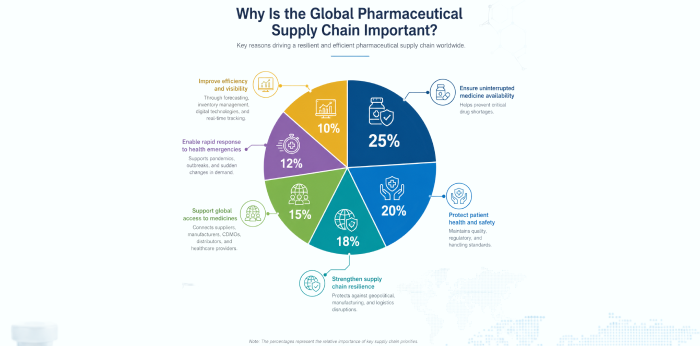
- Ensure uninterrupted medicine availability and help prevent critical drug shortages.
- Protect patient health and safety by maintaining quality, regulatory, and handling standards.
- Enable rapid response to health emergencies, pandemics, and sudden changes in demand.
- Strengthen supply chain resilience against geopolitical, manufacturing, and logistics disruptions.
- Support global access to medicines by connecting suppliers, manufacturers, CDMOs, distributors, and healthcare providers.
- Improve efficiency and visibility through better forecasting, inventory management, digital technologies, and real-time tracking.
Ultimately, a resilient pharmaceutical supply chain ensures that the right medicines reach the right patients at the right time.

Key Challenges Facing the Pharmaceutical Supply Chain
The pharmaceutical industry faces a range of challenges that can affect supply continuity and operational resilience such as:
- Geopolitical and economic uncertainty
- Dependence on concentrated sources
- Regulatory complexity
- Changing demand patterns
- Logistics and transportation challenges
- Demand volatility
These challenges highlight why the modern pharma supply chain needs to move beyond efficiency alone and build the capacity to anticipate, absorb, and recover from disruption.
How Can Pharmaceutical Suppliers Strengthen Supply Chain Resilience?
Resilience starts upstream, with how pharmaceutical suppliers are selected, qualified, and managed. A resilient network isn't built around the cheapest or fastest supplier, it's built around suppliers who can be trusted to perform consistently, even under stress.
Several strategies can strengthen resilience:
- Diversifying suppliers and sourcing locations
- Strengthening supplier risk management
- Improving supply chain visibility
- Building strategic inventory
- Developing contingency plans
Resilience is ultimately strongest when pharmaceutical companies and suppliers work together rather than managing risks independently.
Building a More Flexible and Efficient Pharma Supply Chain
Resilience and efficiency should not be viewed as competing objectives. A well-designed pharma supply chain can improve both by creating greater flexibility across sourcing, manufacturing, inventory management, and distribution.
A more resilient pharma supply chain is typically built on:
- Manufacturing footprint diversity
- Inventory and buffer strategy
- End-to-end visibility
- Integrated development and manufacturing
Piramal Pharma's own network reflects this philosophy. Operating 17 global development and manufacturing facilities with commercial presence across more than 100 countries gives customers meaningful flexibility the ability to configure supply across geographies like India, the US, the UK, and Canada, rather than depending on a single site for a critical product.
How Does Sustainable Development Support Resilient Supply Chains?
Resilience and sustainable development reinforce each other. A supply chain built on responsible sourcing, energy efficiency, and long-term environmental stewardship tends to also be one that's more predictable, more compliant, and less exposed to regulatory or reputational risk.
For example, reducing dependence on resource-intensive processes can help organisations manage exposure to energy and resource constraints. More efficient use of water and energy can also contribute to operational resilience while reducing environmental impact.
At Piramal Pharma, sustainability is integrated into the company's broader approach to responsible growth, with initiatives focused on areas including emissions, renewable energy, water conservation, and waste management across its global operations. The company's most recent Corporate Sustainability Assessment score rose to 63, a 15% improvement year-on-year, and initiatives like the rooftop solar installation at its Digwal facility which generated roughly 607 GJ of renewable reflect how operational resilience and environmental responsibility are being pursued together, not as separate agendas.
Role of Technology and Strategic Partnerships in Supply Chain Resilience
Two forces are increasingly deciding which supply chains hold up under pressure and which don't: technology and partnership.
Digital tools are giving manufacturers earlier warning of disruption, predictive analytics for demand forecasting, real-time visibility platforms for inventory and shipment tracking, and digitized quality systems that reduce the lag between a problem emerging and a response being triggered.
On the partnership side, resilience increasingly depends on collaboration rather than vertical control. Few companies can own every stage of a complex supply chain, so strategic partnerships with suppliers, contract manufacturers, and technology providers.
Piramal Pharma supports customers across the pharmaceutical value chain through its global network and integrated capabilities. Its Contract Development and Manufacturing Organization (CDMO) business works with pharmaceutical and biotech companies across drug development and manufacturing, while its Complex Hospital Generics business supplies critical care products to healthcare systems globally. Its diversified manufacturing footprint and capabilities across multiple markets further support customers seeking reliable and resilient supply solutions.
Building Future-Ready Pharmaceutical Supply Chains
An unpredictable world doesn't call for a rigid supply chain, it calls for one built to flex, absorb shocks, and keep delivering regardless of what happens upstream. That means diversified manufacturing, carefully qualified suppliers, sustainable operating practices, and the right mix of technology and partnership to see disruption coming rather than react to it after the fact.
A resilient global pharmaceutical supply chain requires a combination of diversified sourcing, flexible manufacturing, robust supplier management, digital visibility, strategic partnerships, and responsible sustainable development.
The future-ready pharmaceutical supply chain will therefore not simply be designed to withstand disruption. It will be designed to adapt, recover, and continue delivering what matters most: reliable access to quality healthcare products for patients around the world.
For a global pharmaceutical company like Piramal Pharma, this isn't a single initiative, it's a continuous discipline, built into how facilities are run, how suppliers are chosen, and how sustainability and resilience are pursued together rather than as separate goals. As the pressures on global supply chains continue to evolve, that discipline is what will determine which companies can reliably keep patients supplied no matter what the world throws at them next.
Frequently Asked Questions (FAQ's)
- What are the key challenges facing the global pharmaceutical supply chain?
Key challenges include geopolitical and economic uncertainty, dependence on concentrated sources, regulatory complexity, changing demand patterns, logistics and transportation issues, and demand volatility. - How can pharmaceutical companies build a resilient supply chain?
Pharmaceutical companies can improve resilience by diversifying suppliers and sourcing locations, strengthening supplier risk management, improving supply chain visibility, maintaining strategic inventory, and developing contingency plans. - Why is supplier diversification important in the pharmaceutical supply chain?
Supplier and sourcing-location diversification can reduce dependence on a single source and help pharmaceutical companies maintain supply continuity when disruptions affect a particular supplier, region, or manufacturing location. - How does technology improve pharmaceutical supply chain resilience?
Digital technologies can provide early warnings of potential disruptions, support demand forecasting, enable real-time inventory and shipment visibility, and improve the speed of response when supply chain issues arise. - What does a future-ready pharmaceutical supply chain look like?
A future-ready supply chain combines diversified sourcing, flexible manufacturing, robust supplier management, digital visibility, strategic partnerships, and sustainable operating practices to help companies anticipate, absorb, and recover from disruptions.


Latest Blogs

25.09.2026
Future Outlook of Consumer Healthcare in India
India’s healthcare story is being rewritten - from a predominantly treatment-oriented model towards one that places greater emphasis on prevention
Read More
22.09.2026
Inside the Piramal Pharma Sustainability Report: Our Progress Toward Responsible Growth
Sustainability is no longer a side commitment for pharmaceutical companies — it is fast becoming the framework through which business decisions, operations, and long-term strategy are shaped.
Read More
03.09.2026
How Digital Transformation Is Connecting People, Processes and Decisions Across Pharma
The pharmaceutical industry is no longer just about molecules, manufacturing lines, and regulatory filings.
Read More