From Lab to Launch: The Role of Pharma Development Company in Innovative Medicines
April 13, 2026
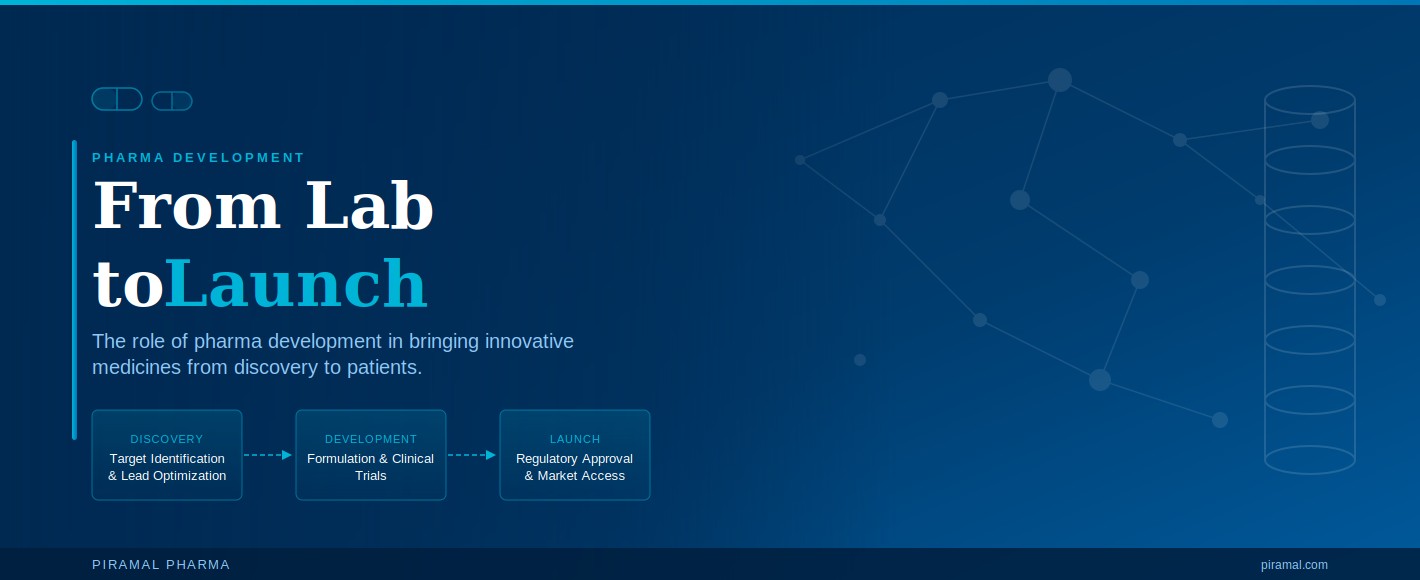
Introduction
The development of innovative medicines requires a structured transition from scientific discovery to commercially viable therapies. Pharma development serves as the critical bridge between early research and scalable manufacturing, ensuring safety, efficacy, quality, and regulatory compliance throughout the lifecycle.
Within modern pharmaceutical ecosystems, development activities integrate chemistry, manufacturing, analytical sciences, regulatory strategy, and clinical execution to translate scientific breakthroughs into approved treatments. This integrated approach enables faster timelines, reduced development risk, and improved patient outcomes.
Pharma companies increasingly rely on end-to-end development partners capable of supporting complex modalities, accelerated timelines, and global regulatory expectations.
Early-Stage Research and Drug Discovery
Early development plays a foundational role in advancing pharma care by ensuring that therapeutic candidates demonstrate both scientific promise and manufacturability. Key activities in early stage programs include:
- Target identification and validation
- Lead molecule optimization
- Developability assessments
- Early safety and pharmacokinetic profiling
- Synthetic route feasibility evaluation
Effective collaboration between discovery scientists and development teams improves success rates by addressing scalability and formulation challenges early in the lifecycle.
Strategic decision making at this stage reduces downstream risks and supports efficient progression toward clinical evaluation while strengthening overall pharma care delivery frameworks.
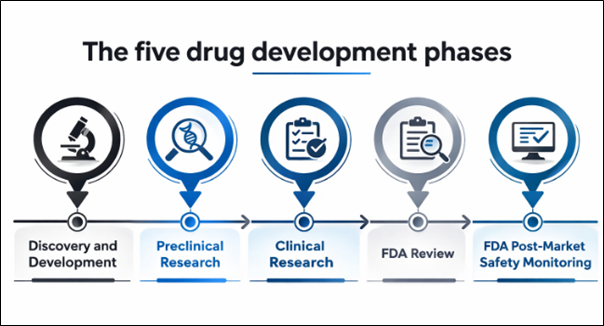
Preclinical Development: Building a Strong Foundation
Preclinical development establishes the scientific basis required to advance pharmaceutical products into human trials. This phase generates critical data supporting safety, dosing rationale, and regulatory submissions. Core preclinical capabilities include:
- Pharmacology and toxicology studies
- ADME characterization (Absorption, Distribution, Metabolism, Excretion)
- Analytical method development and validation
- Formulation feasibility studies
- Process chemistry optimization
Robust preclinical packages enable informed go or no go decisions while preparing Investigational New Drug (IND) submissions. Early investment in scalable chemistry and analytical robustness strengthens long-term success for pharmaceutical products entering clinical development.
Clinical Development and Trials
Clinical development is the structured process of evaluating a drug, biologic, or medical device for safety and efficacy before it reaches patients. It bridges laboratory research and regulatory approval translating scientific data into real-world therapeutic outcomes.
Every clinical program moves through defined phases: first-in-human studies to establish safety profiles, dose-finding trials to identify therapeutic windows, and confirmatory studies that generate the evidence required for market authorization. Each phase demands rigorous planning, cross-functional coordination, and compliance with international regulatory standards.
Clinical development validates therapeutic safety and efficacy while supporting broader healthcare and wellness objectives through evidence based medicine.
Development teams enable clinical programs through integrated operational and technical services:
- Clinical supply manufacturing and packaging
- Stability program design and execution
- Dose form optimization
- Technology transfer readiness
- Global trial logistics coordination
Parallel development models allow formulation, analytical, and manufacturing activities to progress simultaneously, accelerating timelines without compromising quality standards critical to healthcare and wellness outcomes.
Formulation Development and Process Optimization
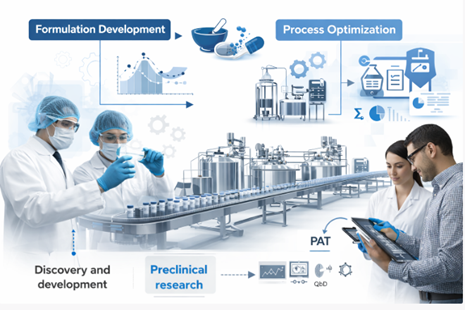
Formulation development is the science of turning an active pharmaceutical ingredient (API) - a raw drug compound into a product that patients can actually take and that their body can absorb.
A molecule that works in a lab doesn't automatically work as a medicine. It might dissolve poorly, degrade quickly, taste terrible, or irritate tissue. Formulation scientists solve these problems by combining the API with excipients (inactive ingredients like binders, fillers, coatings) to create a stable, effective, and manufacturable drug product.
Formulation science is central to successful pharmaceutical products development, particularly for complex molecules with solubility, stability, or delivery challenges.
- Advanced formulation capabilities include
- Modified release and controlled delivery systems
- Injectable and sterile dosage forms
- Particle engineering and solid state characterization
- Excipient compatibility assessment
Process optimization ensures reproducibility from laboratory to commercial scale through:
- Process analytical technology (PAT) implementation
- Scale up and technology transfer strategies
- Continuous manufacturing approaches
- Quality by Design (QbD) frameworks
Regulatory Strategy and Compliance
Regulatory success is not achieved through submission documentation alone, including IND/CTA filings, CMC dossiers, Drug Master Files, and NDA/MAA applications. It is built into the development process from day one as part of effective pharmaceutical drug development. Early alignment with regulatory expectations, well-designed studies, and strong data integrity are critical.
Development teams play a central role in shaping Chemistry, Manufacturing, and Controls (CMC) strategies that stand up to global regulatory scrutiny. A proactive, science-led regulatory approach shortens approval timelines and increases the probability of success in complex pharmaceutical drug development pathways.

Technology and Innovation in Pharma Development
Digital transformation is reshaping drug discovery in pharmaceutical industry workflows and enabling greater efficiency across development programs.
Emerging technologies driving innovation include:
- In silico screening and simulation platforms
- Advanced analytical characterization tools
- Continuous and modular manufacturing systems
- Data driven quality monitoring
Technology adoption also strengthens patient centricity by enabling personalized dosing strategies, improved formulation performance, and enhanced product reliability throughout development.
Patient-Centric Focus in Innovative Medicine: Designing Medicines Around the Patient, Not Just the Molecule
Patient needs are now a defining consideration for major pharma companies in India, influencing decisions across formulation design, delivery mechanisms, and treatment accessibility. Development strategies increasingly incorporate patient experience alongside clinical efficacy.
Design considerations such as dosing convenience, administration routes, and product stability directly affect adherence and therapeutic outcomes. Embedding these principles during development enables medicines to integrate more effectively into real-world treatment environments, reflecting the evolving priorities of major pharma companies in India focused on sustainable healthcare impact.
Powering the Journey from Lab to Launch
Pharma development represents the convergence of science, engineering, and regulatory expertise required to deliver therapies through a structured patient centricity initiative. From early discovery through commercialization, integrated drug development models reduce complexity while enabling innovation to reach patients efficiently and responsibly.
At Piramal Pharma, development operates as a continuous, end-to-end collaboration rather than a sequence of isolated stages. By combining scientific depth, advanced technologies, and a strong patient centricity initiative, innovators are supported in navigating development challenges and accelerating access to transformative therapies.
Frequently Asked Questions
1. What is pharmaceutical drug development and how does it support innovative medicines?
Pharmaceutical drug development is the structured process that transforms scientific discoveries into approved therapies through formulation, clinical evaluation, manufacturing scale up, and regulatory approval. It plays a critical role in enabling innovative medicines to reach patients safely and efficiently.
2. How does formulation development contribute to pharmaceutical products development?
Formulation development is a core component of pharmaceutical products development, ensuring optimal drug stability, bioavailability, and delivery performance. Advanced formulation strategies help address complex molecule challenges and enable scalable manufacturing.
3. Why is regulatory strategy important in pharmaceutical drug development?
A strong regulatory strategy integrates Chemistry, Manufacturing, and Controls (CMC) planning early in pharmaceutical drug development, helping organizations meet global compliance requirements while reducing approval timelines and development risks.
4. How is technology transforming drug discovery in the pharmaceutical industry?
Digital tools, predictive modeling, and advanced analytics are reshaping drug discovery in pharmaceutical industry workflows by improving decision making, accelerating development timelines, and enhancing product quality throughout the lifecycle.
5. What does patient centricity mean in modern pharma development?
Patient centricity focuses on designing therapies around patient needs, including dosing convenience, delivery methods, and treatment accessibility. A structured patient centricity initiative helps improve adherence, outcomes, and overall healthcare impact.


Latest Blogs
15.10.2026
Innovation Beyond the Laboratory
Pharma R&D innovation does not stop at the laboratory. It also shapes how medicines are developed, manufactured, supplied and made accessible to patients
Read More: Innovation Beyond the Laboratory
12.10.2026
Innovation a Key Enabler in Pharmaceuticals
Innovation matters in pharmaceuticals because it makes pharmaceutical development more efficient, informed and scalable.
Read More: Innovation a Key Enabler in Pharmaceuticals
25.09.2026
Future Outlook of Consumer Healthcare in India
India’s healthcare story is being rewritten - from a predominantly treatment-oriented model towards one that places greater emphasis on prevention
Read More: Future Outlook of Consumer Healthcare in India